Dv::Util::charraystream Class Reference
A charraystream provides an input stream on an existing array of characters (which is not copied). More...
#include <charraystream.h>
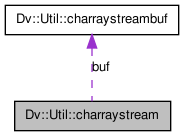
Collaboration diagram for Dv::Util::charraystream:
Public Member Functions | |
| charraystream (const char *begin, size_t size) | |
| Constructor. | |
| std::streambuf * | rdbuf () const |
| We refuse to divulge the streambuf. | |
Private Attributes | |
| charraystreambuf | buf |
Detailed Description
A charraystream provides an input stream on an existing array of characters (which is not copied).
- See also:
- Dv::Util::charraystreambuf
Example usage:
 const char* p = "abc def 123";
 Dv::Util::charraystream is(p, strlen(p));
 std::string s;
 while (is >> s)
   ;
Definition at line 38 of file charraystream.h.
Constructor & Destructor Documentation
| Dv::Util::charraystream::charraystream | ( | const char * | begin, | |
| size_t | size | |||
| ) | [inline] |
Constructor.
- Parameters:
-
begin pointer to the first character in the array size of the array
Definition at line 44 of file charraystream.h.
Member Function Documentation
| std::streambuf* Dv::Util::charraystream::rdbuf | ( | ) | const [inline] |
We refuse to divulge the streambuf.
Note that this definition will also block rdbuf(streambuf*).
Definition at line 50 of file charraystream.h.
References buf.
Referenced by charraystream().
Member Data Documentation
charraystreambuf Dv::Util::charraystream::buf [private] |
Definition at line 52 of file charraystream.h.
Referenced by charraystream(), and rdbuf().
The documentation for this class was generated from the following file: